
A phone came through with a battery reading exactly 100% health. Two and a half years old, visibly used, screen with the scuffs you’d expect. And a perfect, unchanging, impossible battery figure.
That number wasn’t a measurement. It was a value a rewritten controller chip had been programmed to report, and it had been reporting the same thing for months.
The saving on that battery was modest. What it cost, spread across a warning message, an unknowable real capacity, and a discount at resale, was considerably more.
What you’re actually choosing between
Three tiers, and the price gap between them is smaller than people assume.
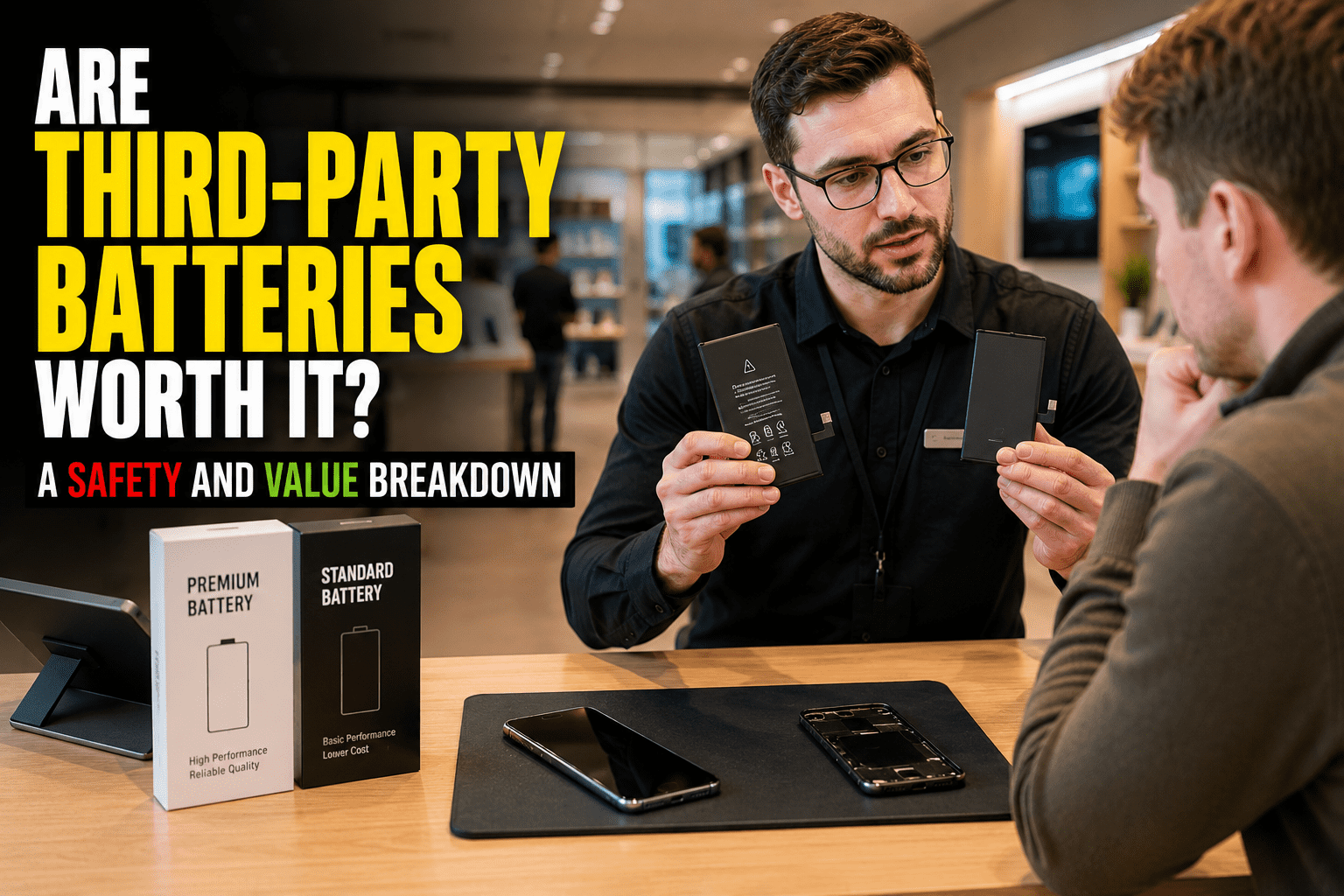
Manufacturer or authorised service. A genuine cell, properly paired, no warnings, full health reporting, and the repair doesn’t damage resale value. Most expensive.
A reputable independent repairer using quality cells. Middle ground. Better cells than the bottom tier, but on devices that verify components, the phone will still flag the battery as non-genuine because the pairing is what’s being checked rather than the quality.
The cheapest available option. Unknown cell, unknown protection circuitry, frequently a rewritten controller, and a phone that reports either a warning or a fiction.
The safety question, honestly
Not scaremongering, and not dismissive either.
A lithium cell is a managed chemical system. What manages it is the protection circuitry — components that cut off charging at the right voltage, prevent over-discharge, monitor temperature, and shut things down when something goes wrong. That circuitry is where a cheap battery saves money, because it’s invisible and the battery appears to work without it doing its job well.
The realistic failure mode isn’t dramatic. It’s swelling. A cell that’s been charged past where it should have been, repeatedly, expands. You notice a screen sitting slightly proud of the frame, or a back panel that no longer sits flush, or a phone that rocks on a table when it used to sit flat.
At that point the phone needs to stop being charged and stop being carried in a pocket. Swollen cells shouldn’t be punctured, compressed, or put in general waste — they go to electronics recycling, ideally soon.
Good third-party batteries from established suppliers exist and behave properly. The problem is that you can’t tell them apart from the bad ones by looking, and the seller fitting them frequently can’t either.
What the phone does about it
This is the part that turns a repair decision into a resale decision.
On iPhone, a non-genuine battery produces a message stating the phone can’t verify it as a genuine Apple battery. On many devices the battery health section stops reporting maximum capacity altogether, replacing a useful number with a warning. The replacement is also recorded in Settings > General > About under parts and service history, permanently.
Losing the health readout matters more than the warning does. You now have no way to know how the battery is actually doing — not as a buyer, not as an owner, not as a seller trying to answer a reasonable question.
The rewritten-controller case is worse. Some aftermarket batteries ship with controllers programmed to report a fixed 100%. No warning, no missing section, just a number that never changes. A buyer who knows what they’re looking at treats a permanent 100% on an old phone as a red flag, which means the workaround designed to hide the problem creates a different one.
On Android, reporting varies. Most manufacturers don’t verify batteries the way Apple does, so a third-party cell may pass unremarked. That’s not an argument that it’s fine — it’s an argument that the buyer will be relying on physical inspection and on your honesty instead.
The capacity claim problem
Third-party batteries frequently advertise capacities above the original.
Treat these with real suspicion. The physical space inside a phone is fixed, and the energy density of available cells is roughly the same for everyone. A replacement claiming substantially more capacity than the factory part, in the same volume, is claiming a chemistry advantage over the manufacturer, which is unlikely.
In testing, high-capacity claims from budget suppliers routinely fail to deliver. Sometimes the cell is simply smaller than stated. Sometimes the controller reports a larger figure than the cell holds, which produces a phone that reports 40% remaining and switches off.
If a battery’s headline feature is more capacity than original, that’s a reason for scepticism rather than a selling point.
When a third-party battery is the right call
Three situations where I’d say go ahead.
The phone is past its support window and you’ll run it until it dies. Resale value is already minimal. Get it working at the lowest sensible cost, from a repairer using decent cells rather than the cheapest available.
Genuine parts aren’t available. Once a model ages past authorised parts supply, aftermarket is the only option. Our repair-or-replace guide covers how that clock works.
It’s a secondary device. A backup phone, a device mounted in a car, a kid’s Wi-Fi-only tablet-substitute. Nobody’s checking parts history and nobody’s selling it later.
Outside those, on a phone with real value that you intend to keep using or sell, the genuine route wins on the arithmetic rather than on principle.
The arithmetic
| Authorised / genuine | Quality third-party | Cheapest available | |
|---|---|---|---|
| Up-front cost | Highest | Middle | Lowest |
| Health reporting retained | Yes | Often lost | Lost or falsified |
| Warning message | None | Usually present | Present, or hidden by a false reading |
| Recorded in parts history | As genuine | As non-genuine | As non-genuine |
| Real capacity | As specified | Usually close | Frequently below claim |
| Protection circuitry | Full | Generally adequate | The thing being economised on |
| Effect on resale | Minimal | Noticeable | Substantial |
| Warranty on the work | Usually | Sometimes | Rarely meaningful |
The row that decides it for most people is the last-but-one. The resale discount a buyer applies to a phone with a non-genuine battery typically exceeds what the cheaper repair saved — and our guide to how replaced parts affect resale value works through why the discount is larger than the fault itself would suggest.
How to choose a repairer if you’re going third-party
If the situation calls for a non-authorised repair, the choice of shop matters more than the choice of part, because a competent repairer sources decent cells and a poor one sources whatever arrived cheapest.
Ask what brand of cell they fit and whether they’ll tell you before the work starts. A shop that names a supplier is a shop that has chosen one.
Ask what warranty covers the work. A meaningful warranty on a battery replacement means they expect it to last.
Ask whether they replace the adhesive seal. Any repair that opens a phone breaks its water resistance, and a shop that replaces the gasket properly is a shop paying attention to the parts you can’t see.
Ask what happens to the health readout. The honest answer on many devices is that it disappears. A repairer who says everything will be exactly as before either doesn’t know or isn’t saying.
Look at how they handle the old battery. A shop with a proper disposal arrangement for lithium cells is a shop that takes the category seriously.
Four straightforward questions, and the answers separate a competent independent repairer from a walk-in counter fitting whatever came in last week’s box.
If you’re buying a phone that already has one
Not automatically a reason to walk. It’s a reason to ask two questions and adjust the price.
When was it replaced, and by whom? A documented repair at a known shop using quality parts is a different situation from an unknown battery of unknown age.
Does the phone still report health? If the readout is gone, you’re buying a battery whose condition nobody can establish. Price accordingly.
Then test it properly: run something demanding for a few minutes and watch whether the charge falls smoothly or drops several points at once. Sudden falls under load are the signature of a cell that isn’t holding up, whatever any number says. Our battery health guide covers the full sequence.
Disposal, which nobody plans for
The end of this story is a battery you need to get rid of, and it’s worth knowing in advance.
Lithium cells don’t belong in general waste. Compressed in a bin lorry or buried in landfill, a damaged cell can ignite, and the fires are difficult to put out. This is a real operational problem for waste services rather than a theoretical one.
A healthy old battery goes to electronics recycling, which most municipalities provide and most repair shops accept.
A swollen battery should be handled carefully — don’t press it, don’t puncture it, don’t leave it charging, and don’t post it. Take it to a recycling point or a repair shop directly, ideally soon rather than storing it in a drawer.
A battery still inside a phone you’re discarding is fine to hand over as a whole device to an electronics recycling scheme. Don’t attempt to remove it yourself; modern phones use adhesive and pull tabs that make DIY removal a good way to puncture a cell.
If you’ve paid for a replacement, the shop should be handling the old one properly, and it’s a reasonable thing to ask about.
Veelvoorkomende fouten om te vermijden
- Choosing a battery repair on price alone. The gap between tiers is smaller than the resale consequence.
- Trusting a 100% reading on an old phone. It’s a claim from a component, not a measurement.
- Believing higher-than-original capacity claims. Physically implausible in the same volume.
- Ignoring a phone that’s stopped sitting flat. That’s swelling, and it needs attention now.
- Charging a swollen battery. Stop, and recycle it.
- Fitting a cheap battery immediately before selling. You get none of the benefit and all of the discount.
- Assuming Android’s silence means it’s fine. It means the buyer will find out another way.
Veelgestelde vragen
Are third-party phone batteries safe?
Quality cells from established suppliers, fitted properly, generally are. The risk sits at the bottom of the market, where protection circuitry is the component being economised on, and you can’t distinguish the tiers by looking.
Why does my iPhone say it can’t verify the battery?
Because the battery isn’t a genuine, properly paired part. The message is permanent, and on many devices the health readout disappears along with it.
Does a third-party battery lower resale value?
Yes, usually by more than the repair saved, particularly on devices that record the replacement in a menu any buyer can open.
Why would a battery report 100% health forever?
Because its controller was programmed to report a fixed value rather than measure one. It’s designed to hide a replacement and ends up signalling it, since a permanent 100% on an old phone is implausible.
What should I do about a swollen battery?
Stop charging and using the phone, don’t press or puncture the cell, and take it to an electronics recycling point or a repair shop promptly.
Can a third-party battery be swapped for a genuine one later?
Yes, and on some devices an authorised replacement clears the warning and restores the health readout. Worth pricing if you’re preparing a valuable phone for sale.
How can I tell what kind of battery a used phone has?
Check the parts history and the battery health screen. A warning message, a missing capacity figure, or an unchanging 100% on an older phone all point to a non-genuine cell.
Is it worth paying for an authorised battery replacement?
On a phone with real value that you’ll keep or sell, yes — it retains health reporting, avoids the warning, and preserves resale value. On a phone at the end of its life, no.
Before you accept any battery quote, ask whether the phone will report the battery as genuine afterwards. That single question separates the three tiers more reliably than the price does.
Buying a phone with a replaced battery? Browse listings on ExploreFrag and check the parts history before you discuss price.
About the author
Emran Ahmed is the founder and CEO of ExploreFrag, a marketplace for buying and selling used phones and accessories across every brand. The permanent-100% battery is his favourite example of a workaround that defeats itself, since the thing designed to conceal a replacement is now the clearest sign of one. He reviews listings most days and checks battery provenance before battery percentage.