


How to Buy a Used Mobile Phone Without Getting Burned
Check IMEI, battery health, and repair history before you pay. A used phone buying guide built from real listings, real sellers, and real mistakes.
Read More


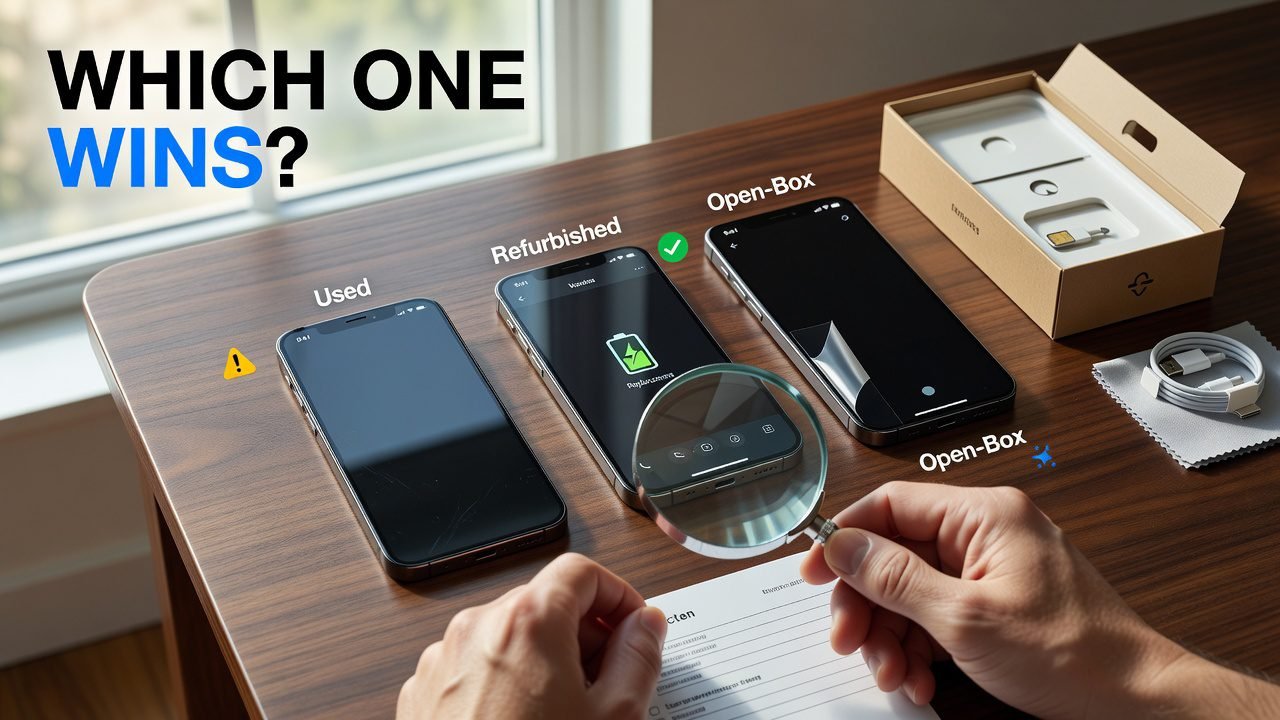
A seller once described a Galaxy S21 as refurbished. Asked what had been refurbished about it, he said he’d wiped it, cleaned the port with a toothpick, and put on a fresh screen protector.
He wasn’t lying, exactly. He was using a word that means almost nothing on its own, and he’d found that it added money to the asking price.
That’s the whole problem with these three labels. Two of them are marketing terms with no fixed definition, one of them has a definition that varies by seller, and buyers pay real premiums based on which word appears in the listing title. Sorting them out is worth a few hundred over the life of a phone.
Forget the marketing. Ask one question about any phone: what was done to it between the last owner and you?
Nothing was done to it. Someone owned it, used it, and is now selling it in whatever state it’s in. Cosmetic wear is whatever it is, the battery is whatever the previous owner left it at, and any repair history belongs to a story you have to ask about.
Used is the honest baseline. No promises, no premium, no warranty — and, because of that, the widest gap between a good buy and a bad one.
Something was done to it. What, exactly, depends entirely on who did the refurbishing, and this is where the term stops being useful. At one end, a manufacturer strips the phone, fits a new battery and new outer glass, retests it, and backs it with a full warranty. At the other end, someone wipes it, buffs the frame, and calls it refurbished.
Same word. Wildly different products.
Nothing was done to it because there was nothing to do. Somebody bought it new, opened it, and returned it inside the return window — sometimes after a week of use, sometimes after twenty minutes, sometimes without ever powering it on. The retailer can no longer legally sell it as new, so it goes out at a discount.
Open-box is the closest of the three to a new phone. It’s also the one with a hidden clock running, which I’ll come back to.
If you take one thing from this piece, take this hierarchy. It explains most of the price variation you’ll see.
Manufacturer certified. Apple’s refurbished programme replaces the battery and the outer shell on every unit, ships it in a plain box with the accessories, and covers it with a one-year warranty that’s eligible for extended coverage. Their refurbished store is the reference example. Samsung runs a comparable programme in some markets, with Certified Re-Newed units getting new batteries and new front and back glass. These are genuinely different objects from what arrives when a marketplace seller uses the same adjective.
Carrier refurbished. Returns and trade-ins processed by a network operator, typically tested and warrantied for a shorter window, often sold locked to that network. Decent quality, narrower terms.
Authorised third-party refurbished. Independent operations with real testing pipelines and genuine parts sourcing. Quality varies by company but is usually consistent within one, and there’s normally a warranty measured in months. Large retail programmes sit here too — the guarantee windows tend to be ninety days to a year rather than the manufacturer-style twelve months.
Seller refurbished. One person, a repair kit, and an aftermarket screen. Sometimes competent, sometimes a phone with a non-genuine display and a battery whose controller reports a permanent 100%. There’s no testing standard, no warranty worth the word, and no accountability once the transaction closes.
The word on the listing is identical in all four cases. My honest position: unless the seller can name who did the refurbishment and what was replaced, treat the phone as used and price it as used. A claim you can’t verify shouldn’t cost extra.
You’ll see A, B, C grades, or Excellent / Very Good / Good, or Pristine / Good / Fair. These systems are internally consistent within one large seller and completely incomparable across sellers.
One company’s Grade A is flawless. Another’s allows light scratches visible at arm’s length. On a peer-to-peer marketplace, where the grade is typed in by the individual selling the phone, it’s a description of their optimism.
Photographs beat grades. Ask for the screen on, on a white background, and a shot of each edge. Our fifteen-point inspection checklist covers what to look for once you have them.
This is the detail that separates a good open-box deal from a mediocre one, and most listings skip it.
A manufacturer warranty generally starts at the original date of purchase — or, in some cases, at first activation — not on the day you buy the phone. So an open-box unit returned to a store six weeks after it was sold gives you a warranty with six fewer weeks on it. If it sat on a shelf for another four months before you found it, you’ve lost that too.
The result is a spectrum. An open-box phone returned three days after purchase and resold two weeks later is effectively a new phone at a discount. An open-box phone from a model generation that launched eighteen months ago may arrive with a warranty that expires before you’ve finished setting it up.
There’s a free way to check. Run the serial number or IMEI through the manufacturer’s coverage lookup — Apple’s coverage checker reports remaining warranty and whether coverage has started, and most large Android brands offer an IMEI equivalent. Ask the seller for the serial before you commit. If they won’t give it, that tells you something.
One more open-box wrinkle worth knowing: buying from a registered business, rather than a private individual, usually comes with statutory rights that private sales don’t carry. In the EU and UK, distance selling by a business brings a cooling-off period; private-party sales bring none. Same phone, same price, very different position if something goes wrong in week two.
| Used | Refurbished (certified) | Refurbished (seller) | Open-box | |
|---|---|---|---|---|
| What changed | Nothing | Battery, outer glass, full retest | Varies, often cosmetic only | Nothing |
| Typical discount | Largest | Moderate | Large, but inconsistent | Smallest |
| Warranty | None | Usually 12 months | Rarely meaningful | Remainder of original |
| Battery | Whatever it is | New | Unknown, possibly aftermarket | Effectively new |
| Genuine parts | Ask | Yes | Frequently not | Yes |
| Accessories | Rarely | Usually included | Rarely | Usually included |
| Return rights | None, private sale | Yes | Depends entirely | Depends on the retailer |
| Best for | Buyers who inspect | Buyers who won’t inspect | Almost nobody at a premium | Buyers who want near-new |
| Main risk | Undisclosed faults | Paying near-new prices | Aftermarket parts, no recourse | Warranty already partly spent |
List price is only half of it.
Used carries the widest spread. Two identical models in identical condition can sit a long way apart on price depending on how motivated the seller is. It also carries a repair-cost tail: a battery at 80% is a phone plus a battery service, and that number should come off your offer rather than out of your savings later.
Certified refurbished costs more up front and eliminates most of the tail. New battery, genuine parts, warranty. The honest trade-off is that on older models the certified price sometimes creeps close enough to a new mid-range phone that the comparison stops being obvious — always check what new money buys you before assuming refurbished is the value option.
Seller refurbished is priced like certified and delivers like used. That’s the whole issue with the category.
Open-box sits nearest to new, and the discount is smallest. Its value is highest right after a model’s launch window, when a genuinely near-new unit becomes available for meaningfully less than retail and the warranty clock has barely moved.
There’s also the resale side, which people forget. A phone with genuine parts and clean service history sells on well. A phone carrying a non-genuine display warning does not, and you’ll discover that in two years when you’re the one writing the listing. Whatever you save buying a poorly refurbished handset, you hand back at the other end.
Four checks that settle most arguments.
Taking a position, since this is the question underneath the whole comparison.
Buy used if you’re willing to run an inspection and negotiate off what you find. It’s consistently the best value per pound spent, and the risk is almost entirely under your control. Our full buying guide covers the process end to end.
Buy certified refurbished if you’re not going to inspect anything, or you’re buying for someone who won’t — a parent, a child, a work device that has to just function. You’re paying for a warranty and a new battery, and for that use case the premium is fair.
Buy open-box if you want current-generation hardware and the discount is real. Check the warranty status first; if the coverage clock is already half spent, the discount needs to be bigger to justify it.
Be sceptical of seller-refurbished at a premium. Not because these phones are all bad — some are competently repaired — but because you’re paying extra for a claim with nothing behind it. Price it as used, and if the seller can document genuine parts and a real warranty, reconsider.
Does a refurbished phone come with a new battery?
Only if the refurbisher says so explicitly. Manufacturer programmes typically fit a new battery as standard; independent and seller refurbishments often don’t touch it at all. Ask directly, and check the reported health against the answer.
Is refurbished better than used?
Better protected, not inherently better condition. A certified refurbished unit gives you a warranty and a fresh battery; a well-kept used phone from a careful owner can be in equal or better physical condition for less money. The right answer depends on whether you’ll do the inspection work yourself.
Is an open-box phone the same as new?
Physically, usually very close. Legally and practically, no — the warranty may have already started, the return rights differ by retailer, and the box has been opened, which means the accessories are worth checking. Verify the coverage status by serial number and you’ll know which kind of open-box you’re looking at.
Can I tell if a phone was refurbished by a manufacturer?
Yes, on iPhone. Certified units show genuine parts in the service history and the serial resolves normally through the coverage lookup. Manufacturer-refurbished stock also usually arrives in a plain white box rather than retail packaging, so the packaging itself is a clue.
Which holds its value best when I go to sell it?
Anything with genuine parts and clean service history. The label it was sold to you under matters far less at resale than whether the display, battery, and camera are original or properly certified replacements.
Does ExploreFrag verify condition claims on listings?
ExploreFrag connects buyers and sellers directly, so condition descriptions come from the individual selling the phone. Verify the parts history, battery, and warranty status yourself before paying, whatever label the listing carries.
Next time a listing uses one of these three words, ask the follow-up question rather than the price question: what was replaced, by whom, and what’s left on the warranty. Sellers who can answer are worth meeting, and the ones who can’t have just given you a discount argument.
When you’re ready to compare real asking prices across all three categories, have a look at what’s listed on ExploreFrag — or, if you’ve got a phone sitting in a drawer, list it for sale and describe it accurately enough to be worth the premium.
Emran Ahmed is the founder and CEO of ExploreFrag, a marketplace for buying and selling used phones and accessories across every brand. He reads condition descriptions for a living, which has made him unreasonably particular about the word “refurbished” and what people think it entitles them to charge. He started ExploreFrag after one too many private sales collapsed over mismatched expectations between a seller’s description and a buyer’s inspection.


