
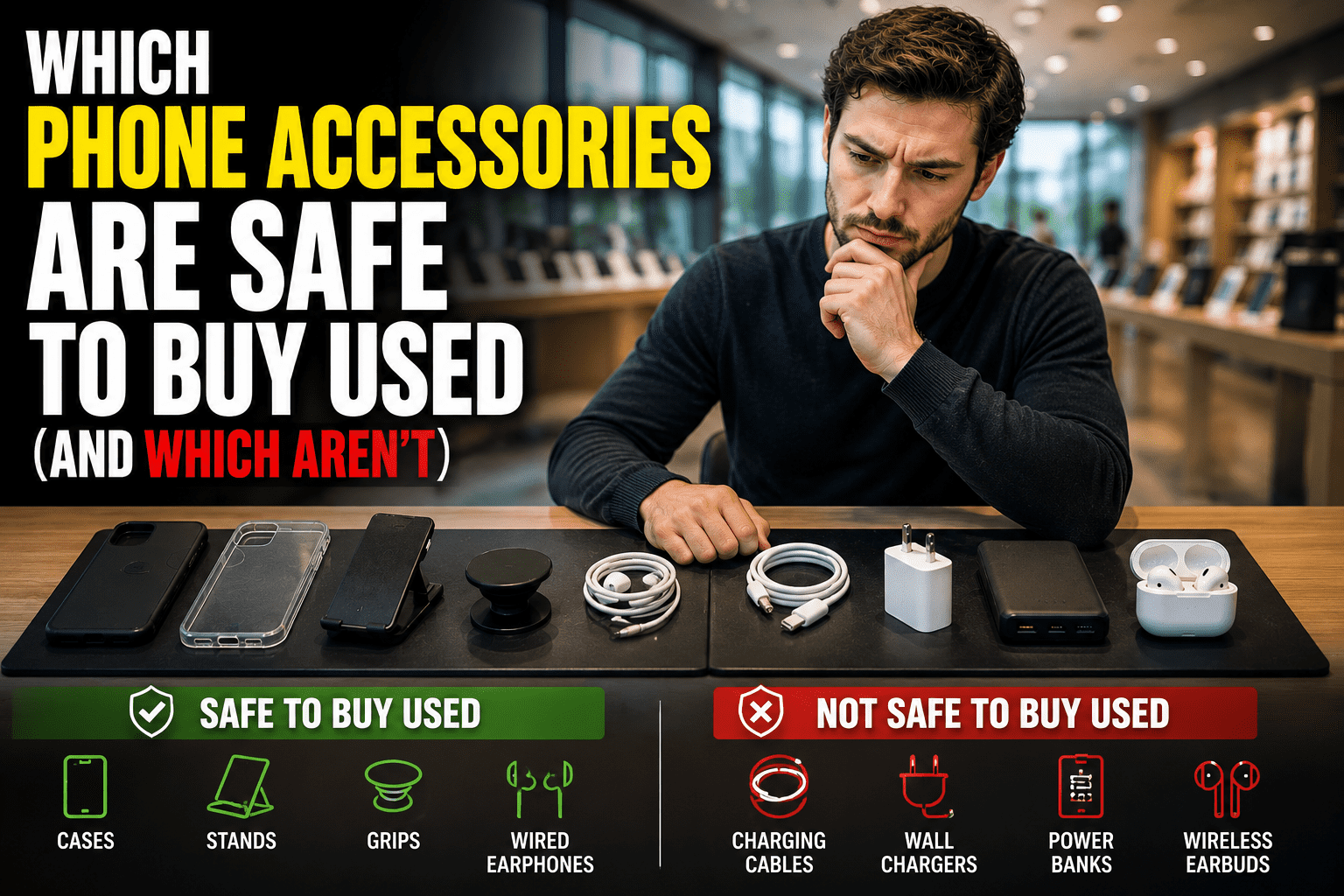
Somebody bought a power bank secondhand for a fraction of retail, used it for a fortnight, and then noticed the casing had developed a slight curve. Not a dent — a bulge, from the inside.
That’s a swollen lithium cell, and it’s the point at which an accessory stops being a bargain and becomes something you carry carefully to a recycling point.
Accessories are the part of the used market where the sensible answer varies wildly by category, and where most advice treats them as one undifferentiated pile. They aren’t. One question sorts nearly all of them.
The question that decides it
Does it contain a battery, and does it touch mains electricity?
Batteries are consumable. They degrade whether the item is used or sitting in a drawer, they can’t be assessed by looking, and when they fail badly they fail in ways that involve heat.
Mains voltage is the other axis. Anything that plugs into a wall socket is separating you from household current using components you can’t inspect, and that separation is exactly what counterfeit manufacturers economise on.
Everything else — the passive stuff, the cables, the plastic — is essentially risk-free secondhand.
| Category | Battery? | Mains? | Verdict |
|---|---|---|---|
| Cases, covers, skins | No | No | Buy freely |
| Wired charging cables | No | No | Buy freely, from known brands |
| Sealed screen protectors | No | No | Buy freely |
| Docks, stands, mounts | No | No | Buy freely |
| Wired earphones | No | No | Buy freely, replace the tips |
| Wall chargers and adapters | No | Yes | Buy carefully, brand matters |
| Wireless charging pads | No | Yes | Test on the spot |
| Memory cards | No | No | Verify real capacity |
| Smartwatches | Yes | No | Buy carefully, check locks |
| Game controllers, keyboards | Yes | No | Buy carefully |
| True wireless earbuds | Yes | No | Buy at a price assuming worn batteries |
| Power banks | Yes | No | Avoid |
Buy freely: the passive category
Cases and covers. A two-year-old case is a two-year-old case. Check for cracks at the corners and whether the lip around the camera is intact, and you’re done. This is the single best value in the accessory market, since cases lose most of their price the moment they leave the shop.
Cables. From a recognisable brand, a used cable is fine. Look at the strain relief where the cable meets each connector — that’s where they fail — and check the connector itself for bent pins or corrosion. A cable that charges and transfers data today will do so for years.
Docks, stands, car mounts, tripods. Passive hardware. Check the clamp tension and whether adhesive mounts still hold, and buy without concern.
Wired earphones. Perfectly reasonable used, with one condition: buy new ear tips. They cost very little and the alternative is unappealing.
Sealed screen protectors. If the packaging is unopened, there’s nothing to go wrong. An already-applied protector, obviously, has no resale value at all.
Buy carefully: mains and moving parts
Wall chargers. The category where brand matters most. A genuine adapter from a manufacturer or a reputable third party is fine used — there’s no consumable inside. A no-name high-wattage adapter is a different proposition, because counterfeit units routinely economise on the isolation between mains voltage and the low-voltage output, which is the component doing the safety work.
Our guide to identifying fake chargers and cables covers the specific tells. The short version: weight, print quality, certification marks that require actual testing, and pin quality.
Wireless charging pads. Test on the spot with your own phone. Coils fail, and a pad that looks perfect can simply not work. Bring the phone you’ll use it with, since alignment and power delivery vary between models.
Memory cards. Two problems, both invisible. Flash memory wears with writes, so a heavily used card can be near the end of its life while appearing fine. More common: counterfeit cards with firmware that reports a large capacity while containing far less, which appear to work until you fill them and discover your files have quietly overwritten each other.
If you buy one used, run a capacity verification tool that writes and reads back the full card before you trust it with anything. It takes time and it’s the only way to know.
Game controllers and Bluetooth keyboards. Batteries inside, but usually larger and less stressed than earbud cells. Check runtime claims against reality if you can, and check that every button and stick registers.
Buy at a discount that assumes the worst
True wireless earbuds. The cells are tiny, non-replaceable, and degrade faster than phone batteries. A three-year-old pair frequently runs a fraction of its original time between charges, and there’s no fixing that.
If you want them used, price them as though the batteries are near the end, because they might be. Check both buds independently — one failing before the other is the classic pattern — and check the case charges both. Then replace the ear tips.
Counterfeits are also rife in this category, more so than in almost any other. Our guide to checking used earbuds and smartwatches covers verification.
Smartwatches. Worth buying used, with a significant caveat: they carry account locks in the same way phones do. A watch that hasn’t been properly unpaired from its previous owner’s account can be unusable, and no amount of resetting fixes it.
Avoid: power banks
The one category I’d tell people to skip outright.
A power bank is a battery in a shell, and everything wrong with buying a used battery applies. Capacity falls with cycles, so a unit that’s been through a few hundred charges delivers noticeably less than the number printed on the case — which was optimistic to begin with.
The safety point matters more. A swollen cell is a genuine hazard rather than a cosmetic complaint, and swelling isn’t always visible until it’s pronounced. Any bulge in the casing, any seam that has opened slightly, any panel that no longer sits flush: stop using it, don’t charge it, and take it to an electronics recycling point.
New power banks from reputable brands are inexpensive. The saving on a used one is not worth the category of risk it introduces.
Where the money actually is
Worth being concrete about which categories reward buying used and which don’t, because the discounts vary enormously.
Cases are the standout. They lose almost all their value the moment they’re opened, so a barely used case from a good brand costs a fraction of retail and performs identically. If you buy one thing secondhand in this category, buy cases.
Docks, mounts, and stands follow the same logic. Nobody wants a used car mount, which is exactly why they’re cheap and exactly why they’re a good buy.
Cables and chargers offer moderate savings. Genuine ones hold value reasonably well used, and the discount isn’t always big enough to justify the verification effort — but it’s real on higher-wattage adapters.
Wearables offer large discounts and carry the most conditions attached, which our wearables checklist works through.
Memory cards offer discounts that look attractive and frequently aren’t, once you account for the risk of a counterfeit and for flash wear you can’t see.
The pattern: the best secondhand value sits in items that are expensive new, cheap used, and impossible to get wrong. Cases and mounts win on all three.
Hygiene, briefly
Not the most interesting section, and worth a paragraph.
Anything that goes in or on your body — ear tips, wrist bands, headband cushions — should be replaced rather than cleaned, and they’re inexpensive enough that this isn’t a real cost. Cases and phones can be wiped down with an appropriate cleaner; avoid anything abrasive on coated surfaces or screens.
For earbuds specifically, the mesh over each driver collects things you’d rather not think about. Check it before buying, and factor replacement tips into the price without embarrassment — every experienced buyer does the same.
Bundled accessories deserve their own scepticism
Here’s a pattern worth knowing when buying a used phone.
Phones frequently arrive with a charger and cable that aren’t the ones they shipped with, because the originals were lost and replaced cheaply at some point. The phone can be entirely genuine while the adapter in the box is a counterfeit.
So value bundled accessories at zero unless you can verify them, and inspect any included charger separately from the phone. A genuine device with a fake adapter is a common combination and the adapter is the part that can damage the phone you just bought.
A quick pre-purchase checklist
- Does it contain a battery? If yes, price it as a consumable.
- Does it plug into mains? If yes, brand and certification marks matter more than price.
- Can you test it now? Wireless pads, controllers, and earbuds should be tested at the meetup.
- Is the capacity claim verifiable? Memory cards need a full write-read check.
- Is anything swollen, bulging, or not sitting flush? Walk away.
- Are the connectors clean and straight? Bent pins and corrosion mean intermittent use ahead.
- Do the ear tips or wrist bands need replacing? Budget for it — they’re cheap.
Common mistakes to avoid
- Treating accessories as one category. A used case and a used power bank are not the same decision.
- Buying a no-name high-wattage charger secondhand. The one accessory that can damage your phone.
- Trusting a memory card’s stated capacity. Verify by writing to it fully.
- Assuming an included charger is genuine. Often it isn’t, and it’s rarely mentioned.
- Buying earbuds at near-new prices. The batteries have been running the whole time.
- Ignoring a slight bulge in a power bank. That’s the warning, not a cosmetic flaw.
- Skipping a test on wireless charging pads. They fail silently.
FAQ
Is it safe to buy a used charger?
From a recognisable brand, yes — there’s no consumable component inside. From an unbranded source, particularly at high wattage, the risk isn’t worth the saving, because counterfeit adapters commonly cut costs on the electrical isolation.
Why shouldn’t I buy a used power bank?
Capacity has already degraded, the degree is unknowable from outside, and a swollen cell is a real hazard. New units from reputable brands cost little enough that the saving doesn’t justify it.
Are used AirPods or other true wireless earbuds worth buying?
Only at a price that assumes the batteries are worn, since the cells are tiny and can’t be replaced. Test both buds separately and budget for new ear tips.
How do I know a used memory card is genuine?
Run a capacity verification tool that writes data across the whole card and reads it back. Counterfeit cards report a false size and silently lose data once you exceed their real capacity.
Can I test a used memory card at the meetup?
Not properly — a full write-and-read verification takes considerable time. Either buy from someone who’ll accept a return, or treat the card as unverified until you’ve run the check at home and keep nothing important on it until then.
Do used cases and cables lose anything with age?
Cases essentially don’t. Cables fail at the strain relief near the connectors, so check both ends — but a cable working today will generally keep working.
Are used chargers from a phone manufacturer safe?
Yes. A genuine adapter contains no consumable part, so age barely matters. The concern in this category is counterfeits, not wear.
Should I buy the accessories bundled with a used phone?
Treat them as a bonus valued at zero unless you can verify them. Bundled chargers are frequently replacements of unknown origin rather than the originals.
Before buying any accessory secondhand, ask the battery question first and the price question second. It sorts almost everything, and it’s the reason a used case is an obvious buy and a used power bank isn’t.
Looking for accessories now? Browse what’s listed on ExploreFrag — and if you’re selling a phone, our bundling guide covers which extras actually raise your price.
About the author
Emran Ahmed is the founder and CEO of ExploreFrag, a marketplace for buying and selling used phones and accessories across every brand. The swollen power bank in the opening was brought to his attention by a buyer who wanted to know whether it was normal. It was not. He now sorts every accessory question by whether the thing contains a battery, which turns out to answer most of them.